The History Buff's Guide to the Civil War by Thomas R. Flagel
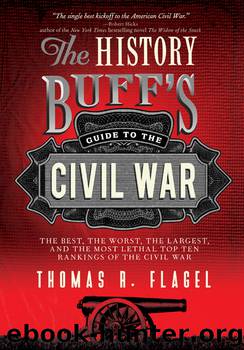
Author:Thomas R. Flagel
Language: eng
Format: epub
Publisher: Sourcebooks, Inc.
Published: 2010-08-27T04:00:00+00:00
* * *
Early in the war, Thomas J. Jackson thought one of his officers would do well leading mounted troops, so he reassigned Jeb Stuart from the infantry to the cavalry.
* * *
2. William Tecumseh Sherman (U.S., Ohio, 1820–91)
He had lived in the South for a dozen years, owned slave servants, and detested the rise of agitating abolitionists. As a result, William Tecumseh Sherman understood the Confederacy better than most any other general in blue.65
Approachable, unceremonious, intense, and highly intelligent, Sherman led his brigade ably at FIRST MANASSAS, one of the few Union officers to do so. Yet he fell into a depression soon after, frustrated by the escalation of the war and the carnage that he was certain would come.
Transferred unwillingly to Kentucky, Sherman told the War Department it would take at least two hundred thousand troops to launch an offensive from the Bluegrass State. Word of his request leaked out, and several newspapers judged him insane. Sherman’s estimations for success were not far off, but he was acting paranoid, claiming that much of Kentucky’s civilian population were Confederate spies.66
Subsequently transferred, Sherman regained himself and his reputation after a solid performance as a division commander at SHILOH, receiving accolades from his immediate superior, ULYSSES S. GRANT. Thereafter, the two men were fast and loyal allies.
In many ways, Sherman was the antithesis of Grant. Better with organization and supply, excitable, racist, and frequently inflexible, Sherman was also a superior strategist. Grant smashed into armies; Sherman outmaneuvered them (with the exception of Kennesaw Mountain, where he lost 2,000 to the Confederates’ 270). Although he lost several battles, he knew how to win campaigns. In 1863 he helped secure the Federal rear at VICKSBURG, assisted in lifting the Confederate siege of Union troops at CHATTANOOGA, and repeated the feat immediately at Knoxville. The next year, Sherman conquered Atlanta, largely by maneuver.67
The campaign for which he is most famous (and infamous) is his late 1864 March to the Sea. Often criticized as a harbinger of “total war” that included civilians, Sherman’s strategy differed little from ROBERT E. LEE’S 1863 campaign into Pennsylvania. Lee intended to take Harrisburg, and fortune willing, the city of Philadelphia; an original version of a march to the sea. Sherman succeeded where Lee failed. And in destroying property, Sherman broke the will of the opposition without forcing the body counts of a COLD HARBOR, a CHANCELLORSVILLE, or for that matter, a GETTYSBURG.68
Download
This site does not store any files on its server. We only index and link to content provided by other sites. Please contact the content providers to delete copyright contents if any and email us, we'll remove relevant links or contents immediately.
| Africa | Americas |
| Arctic & Antarctica | Asia |
| Australia & Oceania | Europe |
| Middle East | Russia |
| United States | World |
| Ancient Civilizations | Military |
| Historical Study & Educational Resources |
Cat's cradle by Kurt Vonnegut(15443)
Pimp by Iceberg Slim(14667)
4 3 2 1: A Novel by Paul Auster(12513)
Underground: A Human History of the Worlds Beneath Our Feet by Will Hunt(12145)
The Radium Girls by Kate Moore(12094)
Wiseguy by Nicholas Pileggi(5841)
The Fire Next Time by James Baldwin(5503)
Perfect Rhythm by Jae(5466)
American History Stories, Volume III (Yesterday's Classics) by Pratt Mara L(5337)
Paper Towns by Green John(5247)
Pale Blue Dot by Carl Sagan(5081)
A Higher Loyalty: Truth, Lies, and Leadership by James Comey(5017)
The Doomsday Machine by Daniel Ellsberg(4552)
The Mayflower and the Pilgrims' New World by Nathaniel Philbrick(4540)
Killers of the Flower Moon: The Osage Murders and the Birth of the FBI by David Grann(4488)
The Sympathizer by Viet Thanh Nguyen(4445)
Too Much and Not the Mood by Durga Chew-Bose(4386)
The Borden Murders by Sarah Miller(4381)
Sticky Fingers by Joe Hagan(4255)
